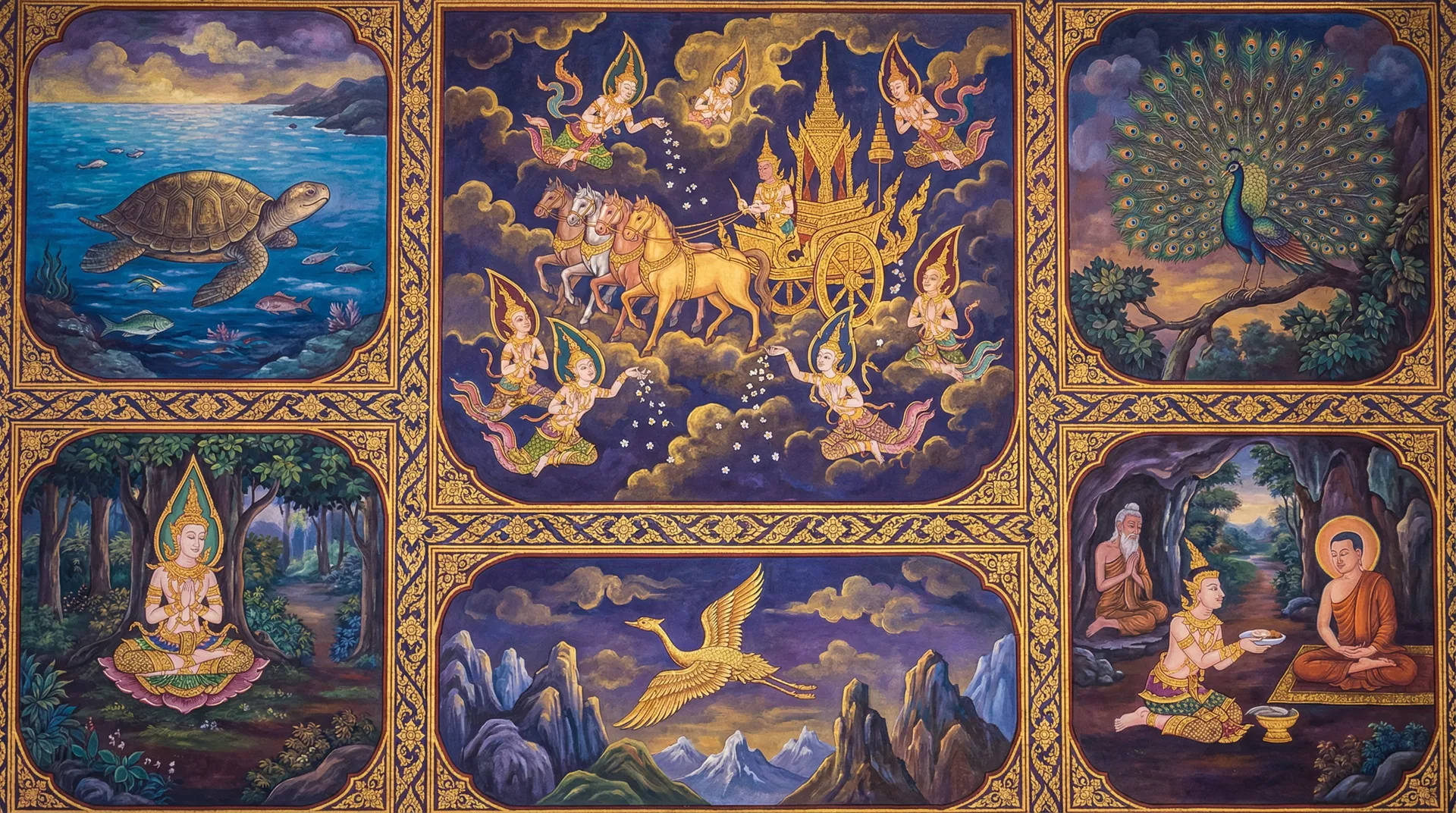
Mugapakkha Jataka
Mugapakkha Jataka
In the ancient land of Magadha, where rivers flowed like veins of life through fertile plains, lived a wise and just king named Supparaka. His reign was a golden age, marked by peace, prosperity, and the unwavering devotion of his subjects. Yet, despite the outward perfection of his kingdom, the king harbored a deep sorrow: he had no heir to inherit his throne and continue his legacy of benevolent rule.
He consulted astrologers, sages, and ascetics, seeking a solution to his predicament. All pointed to the same truth: the king had once been a great Bodhisattva, a being of immense merit, but in a past life, he had harbored a secret resentment towards a rival. This hidden anger, though never acted upon, had created a karmic impediment, preventing him from having a son who would carry on his noble lineage.
The king, upon hearing this, was deeply troubled. He understood that his own past actions, however unintentional, had created this karmic obstacle. He resolved to rectify this past wrong, even if it meant enduring great hardship. He decided to seek out the cause of his past resentment and to make amends.
His quest led him to a remote forest, where he heard tales of a wise and ancient ascetic, who lived in seclusion, meditating on the nature of karma and suffering. The king, with a small retinue, journeyed for many days, his heart filled with a mixture of hope and trepidation.
He found the ascetic in a humble hermitage, his body emaciated but his eyes radiating a profound inner peace. The king approached with respect and explained his plight. "Venerable Sir," he began, "I am King Supparaka of Magadha. I have no heir, and my wise counselors tell me it is due to a past karmic debt. I have come to seek your guidance on how to resolve this."
The ascetic, whose name was Isidatta, listened patiently. When the king finished, Isidatta spoke, his voice calm and resonant. "Your Majesty, the path you seek is one of deep introspection. The impediment you face arises from a past life where you, as a prince named Bodhisatta, harbored ill will towards a rival prince. This resentment, though unspoken, created a shadow on your karmic stream."
King Supparaka listened intently. "And how, Venerable Sir, can I resolve this?"
Isidatta explained, "You must find the one towards whom you harbored this resentment and demonstrate a complete absence of ill will. You must show that you have transcended that past emotion and embraced true forgiveness and compassion. This requires not just outward action, but a transformation of the heart."
The king, understanding the gravity of the task, thanked the ascetic and vowed to fulfill his guidance. He returned to his kingdom, his mind filled with the words of Isidatta. He spent days in deep contemplation, trying to recall the specifics of that past life, the nuances of his resentment.
He learned that the rival prince, in that past life, had been abandoned by his followers and was living in poverty and obscurity in a distant village. King Supparaka, without revealing his past connection, decided to help this man. He sent emissaries to the village, not to punish or to gloat, but to offer assistance.
The emissaries, under the king's direct orders, provided the former rival prince with funds, land, and resources to rebuild his life. They ensured he was treated with respect and dignity. The king himself, disguised as a humble traveler, visited the village and observed the man from afar, ensuring his well-being without revealing his identity or past animosity.
What the king did next was even more profound. He sought out the former rival prince, who was now living a comfortable life, and, in a public ceremony, publicly praised him for his resilience and ingenuity in overcoming adversity. He presented him with further gifts and honored him with titles, treating him as an esteemed peer and friend.
The former rival prince was deeply touched and bewildered by the king's unexpected generosity and public affirmation. He could not comprehend why the king, who he had once considered an enemy, would treat him with such kindness and honor.
King Supparaka, in his heart, was demonstrating a complete absence of malice. He had forgiven the past, not out of weakness, but out of a deep understanding of impermanence and the suffering caused by resentment. He acted with genuine compassion, wanting the best for the man, regardless of their past.
He continued this practice for many years, consistently demonstrating goodwill, generosity, and respect towards the man who was once his rival. He showed no hint of past grievance, no trace of bitterness. His actions were a testament to a heart that had truly let go of all ill will.
Slowly, the karmic knot began to loosen. The king felt a lightness in his spirit, a sense of inner peace that he had not experienced before. His compassion had finally extinguished the embers of past resentment.
One auspicious day, as King Supparaka sat on his throne, a radiant light filled the court. He felt a profound sense of fulfillment. Shortly thereafter, the queen conceived, and in due time, gave birth to a son. The child was healthy, strong, and possessed a disposition of great kindness and wisdom, mirroring the king's own virtues.
The king rejoiced, not just for himself, but for the understanding he had gained. He realized that true strength lay not in holding onto grievances, but in releasing them. His act of profound forgiveness and selfless goodwill had not only cleared his karmic path but had also brought immense peace to his own heart.
The birth of his son, Prince Mandhatr, was celebrated throughout the kingdom, a symbol of the king's triumph over his past and the power of a truly transformed heart. The story of King Supparaka and his journey to overcome past resentment became a cherished teaching, illustrating the profound impact of genuine forgiveness and the release of ill will.
— In-Article Ad —
💡Moral of the Story
Genuine forgiveness and the complete release of past resentment, demonstrated through consistent acts of goodwill and compassion, can overcome karmic obstacles and bring about profound inner peace.
Perfection: Forgiveness / Generosity (Dana Paramita)
— Ad Space (728x90) —
More Jataka Tales You May Enjoy
 509Pakiṇṇakanipāta
Sama Jataka
The Blind Ascetic and His Devoted SonIn the verdant land of Savatthi, there lived a venerable asceti...
💡 Reckless actions, even unintentional ones, can have devastating consequences. True repentance involves not only acknowledging wrongdoing but also dedicating oneself to good deeds and compassion.
 319Catukkanipāta
Maha-Ummagga Jataka
Maha-Ummagga JatakaIn the heart of the ancient kingdom of Mithila, under the reign of the wise King ...
💡 Profound intelligence, foresight, and logical reasoning are essential for effective leadership, capable of overcoming even the most daunting challenges and ensuring the prosperity and well-being of a kingdom.
 389Chakkanipāta
Mahasutasoma Jataka
Mahasutasoma JatakaIn a distant land, where ancient trees touched the heavens and rivers flowed like...
💡 True power lies in wisdom, compassion, and self-control, not in force or selfish indulgence. Understanding the nature of suffering and craving is the path to liberation.
382ChakkanipātaSutasoma Jātaka
Sutasoma Jātaka Long ago, in the vibrant city of Indapatta, ruled a king named Piliya, a monarch who...
💡 True victory is achieved not through violence and conquest, but through wisdom, compassion, and the ability to show mercy.
312CatukkanipātaMahosadha Jataka
Mahosadha JatakaIn the ancient city of Mithila, renowned for its bustling marketplaces and magnifice...
💡 True wisdom lies in understanding the heart of matters and the nature of beings, leading to just and insightful solutions.
 351Pañcakanipāta
Nimi Jataka
Nimi Jataka In the heart of a thriving kingdom, ruled a just and wise monarch named King Nimi. His r...
💡 True happiness lies not in external pleasures or worldly possessions, but in the cultivation of inner virtues and selfless service.
— Multiplex Ad —